
A couple of years ago, the hard question about generative AI was whether it could work at all. That question is settled. The one that keeps enterprise teams up at night now is narrower and far more uncomfortable: can you trust the output enough to put your name on it?
That's the gap Retrieval-Augmented Generation closes, and it's why RAG has quietly become the default way serious organizations ship AI. The models keep getting smarter, but raw reasoning power was never the real constraint. The constraint is whether the system is working from the right information — current, governed, and specific to your business — at the moment a user asks the question.
RAG isn't "vector search plus a prompt" anymore
If your mental model of RAG is still "embed some documents, stuff the matches into a prompt, hope for the best," you're picturing a 2023 demo. What runs in production today looks more like a pipeline with several distinct stages, each of which can quietly sink the whole thing if you skip it.
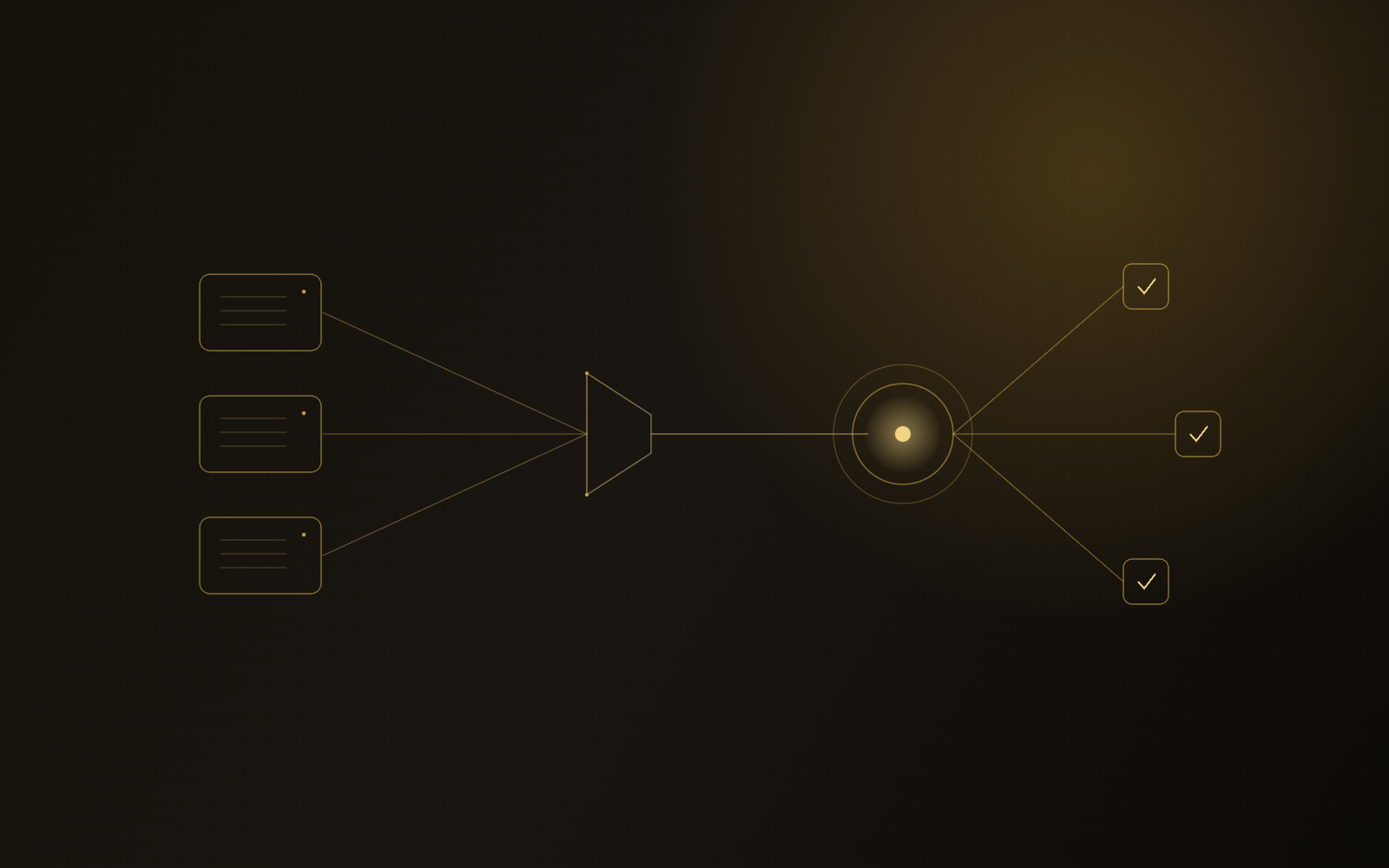
It starts before retrieval even happens, with figuring out what the user actually wants — a lookup, a comparison, a summary. From there the system pulls from multiple sources at once: your databases, document stores, internal APIs, and knowledge bases, rather than a single index. Retrieval itself usually blends two methods, dense semantic search for meaning and keyword search for the exact terms and codes that semantic search tends to miss.
Then comes the part most prototypes leave out. Before anything reaches the model, results get filtered for security and relevance, and a second-pass re-ranker scores the survivors and forwards only the strongest handful. That single step does a lot of unglamorous work: it cuts noise, trims token cost, and keeps latency down by refusing to dump fifty mediocre chunks into the context window.
The generation step is where enterprise RAG really separates from a consumer chatbot. The model is told to answer from the retrieved material only — not from whatever it absorbed during training. This "closed-world" approach is what makes the output defensible. And every answer carries citations back to its sources, so a response can be checked rather than simply believed.
The business case has stopped being a leap of faith
What's changed in 2026 is that the ROI conversation is grounded in results instead of slide decks. The pattern we see repeatedly is that grounding a smaller, cheaper model in good context will often beat a much larger model running blind — which flips the usual "bigger is better" instinct on its head and saves real money.
Industry reporting points in the same direction: meaningfully lower retraining costs because you update the knowledge base instead of the model, fewer hallucinations once answers are tied to authoritative sources, and lower token spend once re-ranking stops you from over-feeding the model. (Worth a caveat: a lot of the headline percentages floating around come from vendor blogs and analyst summaries, so treat them as directional rather than precise. The direction, in our experience, holds up.)
There's a quieter benefit that rarely makes the ROI spreadsheet but matters just as much. A good RAG system turns scattered institutional knowledge into something anyone can query. A new hire can ask about a decade-old internal process on their first morning. A junior analyst gets the same access to hard-won context as the person who's been there fifteen years. Onboarding shrinks, and the knowledge that used to walk out the door with departing employees stays put.
Compliance is now a reason to build, not a box to tick
For anyone in finance, healthcare, or insurance, the regulatory backdrop has changed the calculation. Under frameworks like the EU AI Act, "the model said so" is not an acceptable explanation. You need to show your work.
This is where RAG's architecture turns into a genuine advantage rather than overhead. Source-backed citations give you an audit trail by default. Closed-world reasoning keeps the model from inventing facts or leaking training data. And because filtering happens at retrieval time, a user only ever sees what they're cleared to see. Explainability that used to be a feature request is baked into the design.
Agentic RAG: from per-app pipeline to shared runtime
The most interesting shift this year is architectural. Instead of bolting a separate retrieval pipeline onto every application, more teams are treating RAG as shared infrastructure — a single knowledge runtime that every app and agent draws from. Build it once, govern it once, reuse it everywhere.
On top of that runtime, agentic systems are starting to appear in production: AI that doesn't just retrieve and answer but decides what to look up, when to look again, and which tool to reach for. Adoption is real and growing, and reported returns are encouraging, though as with all of this, the strongest numbers tend to come from the companies selling the platforms. The structural logic is sound regardless of the exact figure.
Why so many RAG projects still fail
There's a widely repeated claim that the large majority of RAG implementations don't make it to dependable production. The specific percentage is debatable, but the underlying observation matches what we see, and the failure modes are remarkably consistent.
Most of them come down to treating RAG as a weekend prototype rather than a production system. Teams stand up a vector database, get an impressive demo, and assume the hard part is done — then skip the re-ranking, ignore data quality at the retrieval layer, forget security filtering until an auditor asks, and ship without citations. None of these are exotic problems. They're the predictable cost of mistaking a proof-of-concept for a product.
What it costs, realistically
Pricing varies enormously with scale and complexity, and you should be wary of anyone quoting a single number. A modest internal deployment is a very different animal from a multi-source, compliance-heavy system serving thousands of users. The cost lives in infrastructure and the vector database, the data pipelines, any licensed re-ranking models, the security and compliance layer, and — the line item people consistently underestimate — testing and validation.
The market itself is growing fast on every analyst's chart, which is less interesting than what it signals: RAG has moved from experiment to expected. If your competitors are turning proprietary knowledge into a queryable advantage and you aren't, that gap compounds.
The patterns that survive contact with real users
Strip away the noise and the architecture that holds up in production is fairly consistent. Hybrid search so you catch both meaning and exact terms. A cross-encoder re-ranker so precision doesn't collapse at scale. Retrieval across all your sources, not just one. Closed-world reasoning to keep the model honest. Citations on every answer. Security filtering before ranking, never after. And increasingly, a shared knowledge runtime instead of a tangle of one-off pipelines.
Low-code tools like Dify and Flowise have also lowered the barrier, letting teams outside core engineering build governed RAG apps without reinventing the plumbing — useful, as long as the governance is real and not just a setting nobody checked.
The bottom line
The lesson of 2026 is almost counterintuitive: the precision of the context now matters more than the power of the model. The organizations pulling ahead aren't the ones with the biggest model. They're the ones who treated retrieval as serious infrastructure — grounded, governed, and built to be trusted.
If you're building enterprise AI this year, RAG isn't one option among several. It's the foundation that makes the rest reliable, compliant, and worth the investment.
At Radiant Code & Connect, we design and ship production RAG systems — hybrid retrieval, re-ranking, closed-world reasoning, and the compliance layer that makes them audit-ready. If you're moving from prototype to production, let's talk.