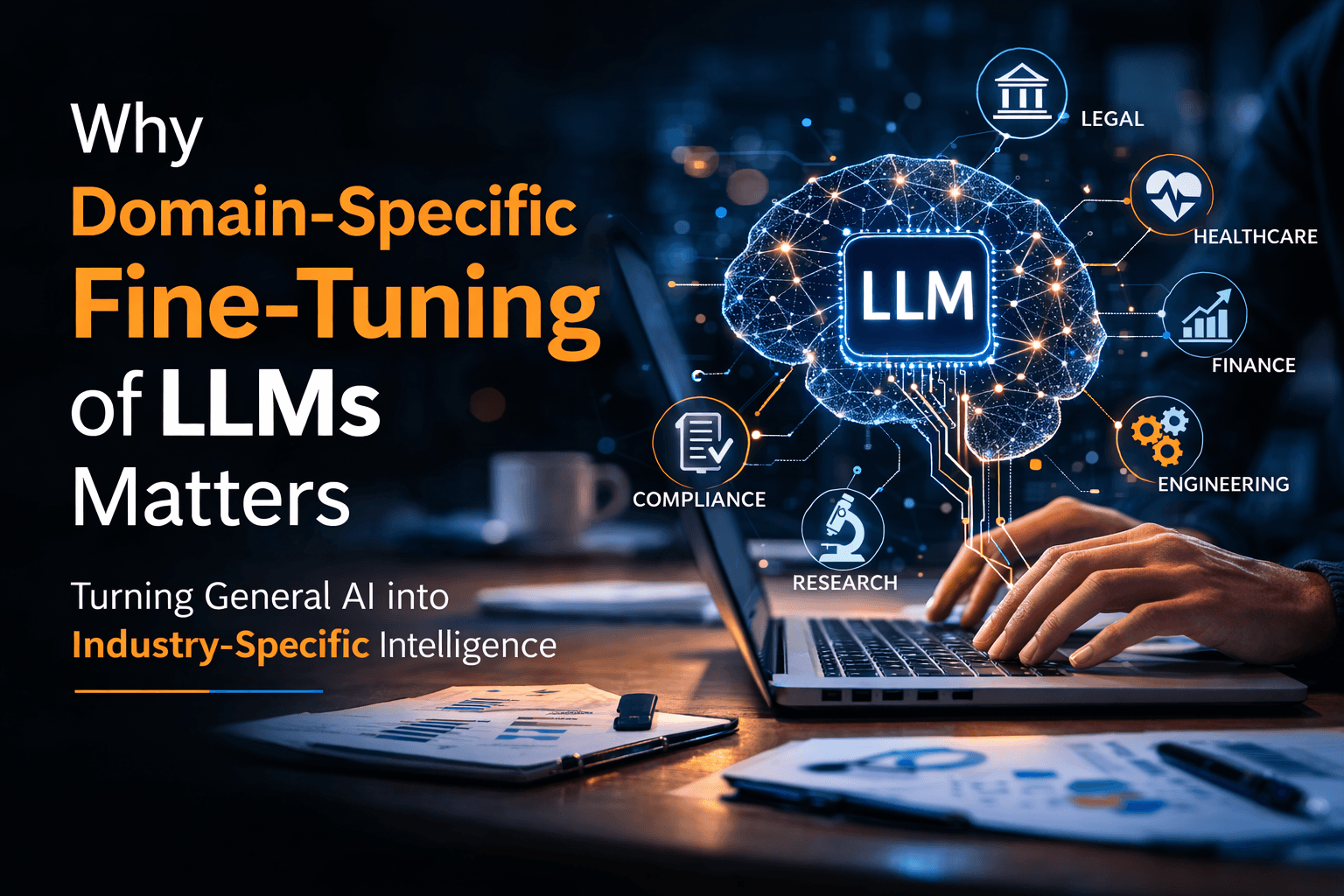
Large Language Models (LLMs) have become incredibly capable tools. They can summarize documents, answer questions, and generate content with impressive fluency. However, when these models are applied to specialized industries such as finance, healthcare, law, or engineering, their general knowledge often isn’t enough.
This is where domain-specific fine-tuning becomes critical.
Fine-tuning allows a general LLM to adapt to a particular field by training it further on domain-relevant data. Instead of relying only on broad internet knowledge, the model learns the terminology, structure, and reasoning patterns used by professionals in that industry.
The Problem with General LLMs
Most LLMs are trained on extremely large datasets gathered from books, websites, and other publicly available sources. This gives them strong language understanding, but it does not necessarily give them expert-level knowledge of specialised domains.
In fields such as finance or medicine, documents contain precise terminology and structured reasoning. A generic model may understand the language but still miss the deeper meaning or importance of certain phrases.
As a result, outputs may be:
- Technically correct but shallow
- Missing important context
- Inconsistent with professional standards
For systems used in real-world decision making, these limitations can become significant.
What Fine-Tuning Changes
Domain fine-tuning teaches the model how language is used within a specific professional context.
By training on domain documents such as reports, regulatory filings, research papers, or technical manuals, the model gradually learns:
- Domain-specific vocabulary
- How experts structure information
- How concepts relate to each other within that field
The result is a model that behaves less like a general assistant and more like a domain-aware system.
A Practical Example
Imagine using an LLM to analyze corporate financial reports.
A general model may summarize the document correctly, but it might not recognize subtle indicators of financial risk or unusual disclosure language.
After fine-tuning on financial filings and regulatory documents, the model begins to recognize patterns that matter to analysts—such as deviations in revenue reporting or unusual liability disclosures.
The difference is subtle but important.
A general model reads the document as text.
A fine-tuned model reads it with industry context.
Fine-Tuning vs Prompt Engineering
Many teams try to guide models using carefully designed prompts. While prompts can improve responses, they do not fundamentally change the model’s understanding of a domain.
Fine-tuning works at a deeper level. It reshapes how the model interprets language, allowing domain knowledge to become part of the model itself rather than something it is temporarily instructed to follow.
Final Thoughts
General LLMs provide an excellent starting point, but professional environments often require deeper expertise.
Domain-specific fine-tuning helps bridge this gap by teaching models the language, structure, and context of a particular field. The result is a system that produces more accurate, reliable, and meaningful outputs.
As organizations continue adopting AI in critical workflows, fine-tuned models will play an increasingly important role in building AI systems that professionals can truly trust